
• Skip To Content
  • Skip To Navigation
  • Skip To Search
  • About
    • People
    • History
    • 24-25 Year in Review
    • Facilities
    • Giving
    • About the Art
  • Education
    • Undergraduate
    • Graduate
  • Research
    • Virtues & Vocations
    • Justice Labs
    • SPIRE: Scholarship in CST
    • Higgins Labor Program
    • Journal of Poverty and Public Policy
  • Community
    • Collaboratory
    • Carceral Engagement
    • Gatherings
  • Happenings
    • Calendar
    • Institute Stories
    • A Question of Justice
    • The Current
    • Book Club
  • Resources
    • Community Cases
    • Integrating Virtue Together
    • Virtues in Engineering
  • Engage with Us

University of Notre Dame

Institute for Social Concerns Logo

  • About
    • People
    • History
    • 24-25 Year in Review
    • Facilities
    • Giving
    • About the Art
  • Education
    • Undergraduate
    • Graduate
  • Research
    • Virtues & Vocations
    • Justice Labs
    • SPIRE: Scholarship in CST
    • Higgins Labor Program
    • Journal of Poverty and Public Policy
  • Community
    • Collaboratory
    • Carceral Engagement
    • Gatherings
  • Happenings
    • Calendar
    • Institute Stories
    • A Question of Justice
    • The Current
    • Book Club
  • Resources
    • Community Cases
    • Integrating Virtue Together
    • Virtues in Engineering
  • Engage with Us
  • Home
  • Menu
Good Read
January 2024

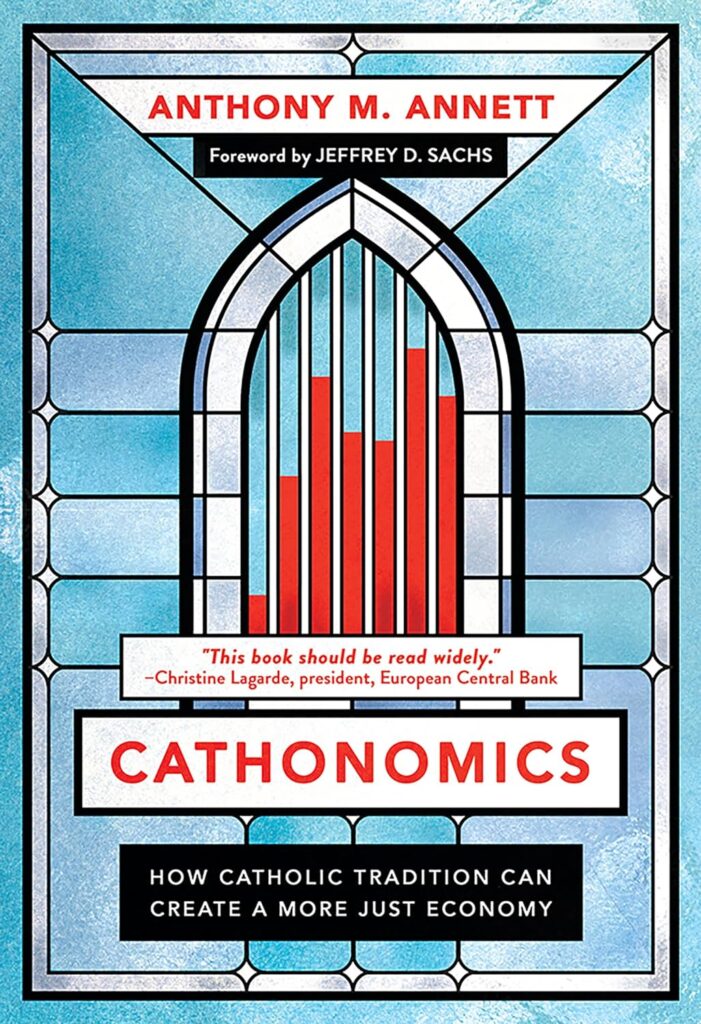
Cathonomics by Anthony Annett

Cathonomics

In 2013 Jorge Mario Bergoglio was elected pope, taking the name of Saint Francis of Assisi to signal his commitment to serving the poor and the disenfranchised. This commitment has not only shaped how Francis governs the church, but also how he thinks about the economy. In a speech given to the poor of Bolivia, Pope Francis is clear that economic policy should be focused first and foremost on human well-being, saying that “the first task is to put the economy at the service of people. Human beings and nature must not be at the service of money.” But what exactly would it look like to build an economy centered on serving the poor and promoting human flourishing? 

In Cathonomics (Georgetown University Press, 2022), Tony Annett lays of a vision inspired by Catholic social teaching for a just and humane economy. Drawing from Aristotle, Aquinas, and several recent popes, Annett argues that concepts like human dignity, solidarity, and subsidiarity can provide the moral grounding necessary for an economy that goes beyond purely mathematical metrics like GDP to achieve the ultimate goal of improving human lives. Annett explores how these concepts apply to perennial questions about capitalism, unemployment, inequality, and climate change, making the case that the principles of the social tradition can help us create a world that prioritizes economic growth only insofar as it supports actual human flourishing.

PrevPreviousVirtuous Democratic Dialogue
NextPractical HopeNext
Explore All
GOOD THOUGHT
GOOD READ
GOOD WORK
Recent Articles

GOOD THOUGHT

Joy: Its Nature and Contribution to Human Flourishing
Robert A. Emmons

GOOD READ

Wild Dark Shore by Charlotte McConaghy (2026)
Samantha Deane

GOOD WORK

Solving Wicked Problems Starts with Who You Are: Character Education and the ‘Wicked Festival’ at Radford University
Dustin Webster

Institute for Social Concerns

Geddes Hall
Notre Dame, IN 46556 USA
Phone (574) 631-5293 socialconcerns@nd.edu

  • Facebook
  • Instagram
  • YouTube
  • LinkedIn

© 2026 University of Notre Dame

University of Notre Dame
  • Search
  • Mobile App
  • News
  • Events
  • Visit
  • Accessibility
  • Facebook
  • Twitter
  • Instagram
  • YouTube
  • LinkedIn
View All Events

Upcoming Events

2026 Senior Send-off Ceremony

May152026
Time: 7:00 pm - 8:00 pm

Virtues & Vocations Annual Conference

Jun12026
All-day event

Alumni Book Club: TBD

Jun12026
Time: 7:00 pm - 8:15 pm

Virtues & Vocations Annual Conference

Jun22026
All-day event

Virtues & Vocations Annual Conference

Jun32026
All-day event

ND Alumni Reunion Open House

Jun52026
Time: 3:30 pm - 4:30 pm

MVP Fridays: Michigan State

Sep182026
Time: 4:00 pm - 5:00 pm

MVP Fridays: Stanford

Oct92026
Time: 4:00 pm - 5:00 pm

MVP Fridays: Miami

Nov62026
Time: 4:00 pm - 5:00 pm

MVP Fridays: Boston College

Nov132026
Time: 4:00 pm - 5:00 pm