
encounter Lecture ARchive
The 2025 Encounter lecture series featured political theologian Anna Rowlands, Christian ethicist Marcus Mescher, and theologian Victor Carmona. Learn more about the 2026 Encounter series.
Anna Rowlands: “Simone Weil, Catholic Social Thought, and Contemporary Society”
Friday, February 7, 2025

Anna Rowlands, the St. Hilda Chair in Catholic Social Thought and Practice at Durham University, England, and author of Towards a Politics of Communion: Catholic Social Teaching in Dark Times, kicked off the 2025 series by recounting the life and writings of twentieth-century French philosopher, activist, and mystic Simone Weil and her unexpected relevance to the themes of Pope Francis’s social teaching on political community.
As a refugee in Europe and later the United States during World War II, Weil wrote on the concept of “rootedness” as “the most significant yet difficult to define and often overlooked spiritual need of the human person,” Rowlands explained. In her 1943 work The Need for Roots, Weil contrasts rootedness with “uprootedness,” which she describes as the severing of ties to one’s history and community.
In her talk, Rowlands drew parallels between Weil’s text and Pope Francis’s Fratelli tutti, published nearly 80 years later. There Francis writes that “there is no worse form of alienation than to feel uprooted, belonging to no one.” In a time of increasing isolationism and xenophobia, Rowlands highlighted Pope Francis’s counter-cultural emphasis on care for migrants, arguing that “the politics of rootedness is fast becoming a defining political drama of our age.”
Marcus Mescher: “The Ethics of Encounter and Catholic Social Teaching”
Friday, February 28, 2025

Marcus Mescher, associate professor of Christian ethics at Xavier University, drew from his book The Ethics of Encounter: Christian Neighbor Love as a Practice of Solidarity to engage stories of encounters in the Gospels and Mescher’s own life in order to invite students to practice what Pope Francis called “the art of encounter.”
“Ultimately, experiences are less about what we do for people than about being with and being changed through those encounters,” Mescher stated. “Encounter is the floor and not the ceiling. It’s just the entryway into where we need to go, which is relationships marked by mutual respect, genuine concern, and a robust spirit of co-responsibility.”
According to Mescher, “the end goal, the vision, is friendship. It’s not feeling sorry for people. It’s not just merely tolerating differences. It’s trying to create the conditions for courage, compassion, generosity, humility, and the fidelity to remember that at the end of the day we belong to each other as equal members of God’s family.”
Victor Carmona: “Migration: A Prism of Encounter with God, Self, and Neighbor”
Friday, April 11, 2025
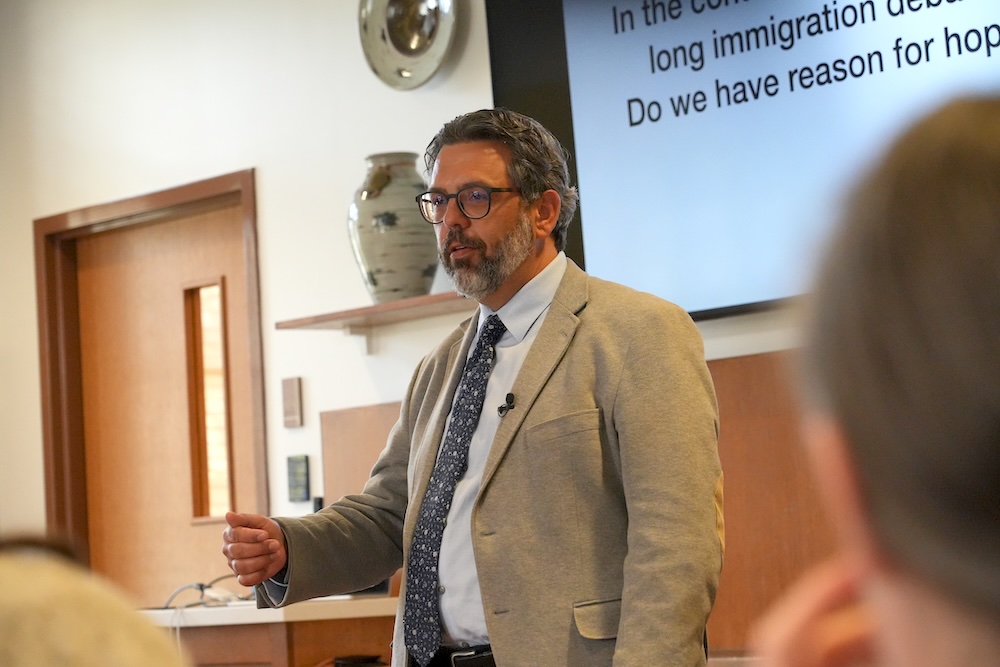
Victor Carmona, associate professor of theology and religious studies at the University of San Diego, described his own life-changing encounter with Maria, whom Carmona met in South Bend during his graduate studies at Notre Dame. “Just the experience of meeting Maria and seeing how she navigated the challenges of being a single mom, while also being an undocumented immigrant here in South Bend, shook me to my core, and it grounded me as a theologian.” After meeting Maria, Carmona wrote his theology dissertation on a critique of US immigration policy. He ultimately dedicated his dissertation to Maria and named his daughter after her.
In his talk, Carmona expounded on his theological critique of US immigration policy, drawing insights from Catholic social tradition and the writings of Pope Francis. According to Catholic social tradition, he explained, migrants have a “right to residency,” which requires host countries “to welcome, to protect, to promote, and to integrate.”
“Integration, which is neither assimilation nor incorporation, is a two-way process, rooted essentially in the joint recognition of the other’s cultural richness,” the pope stated to those gathered at the 2017 International Forum on Migration and Peace. Carmona argued that “Francis, on the basis of Catholic social teaching, is actually quite demanding, as he should be.”
Recalling a statement by Cardinal Baggio that “migrants are a sacrament of God’s presence among us,” Carmona reflected, “This is why encounter is so important—because ultimately when I encounter the migrant as I did with Maria and with many others, I’ve encountered Christ in them, and I’ve been transformed for the good.”
“This is why I think the work of places like this institute is absolutely essential for Catholic higher education,” Carmona said during his visit. “There’s only so much encountering you can do inside the classroom. There’s only so much encountering that you can do that engages not just the mind but the heart, and I think this is where encountering matters deeply.”